How coordination, reliable information and market demand support the management of Ontario’s end-of-life tires
October 1 marks the start of Circular Economy Month, a time for Canadians to learn more about what a circular economy is, why it matters and how we can all contribute.
Understanding circularity begins with looking at the products and materials around us differently. Rather than following a linear model in which resources are extracted, made into products, used and discarded, a circular economy looks for practical ways to keep products and materials in use for as long as possible.
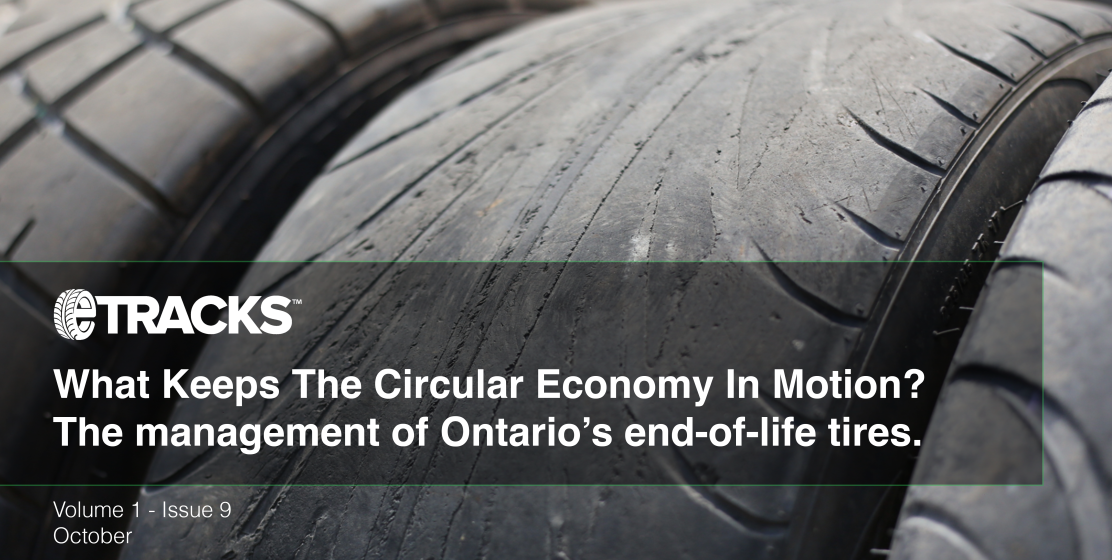
For Ontario’s end-of-life tires, this may mean continued use, retreading or processing to recover materials such as rubber, steel and fibre. These pathways rely on coordinated services, accurate records and markets for recovered resources.
Looking at how these elements work together helps illustrate an important principle of circularity: keeping value in use requires more than one action or organization.
More Than One Path
The condition of an end-of-life tire helps determine what happens next. Some tires may be suitable for continued use, while suitable tire casings may be retreaded by replacing the worn tread.
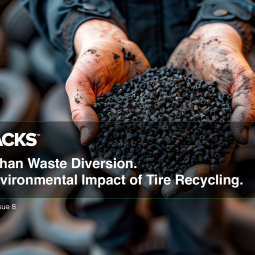
Other tires may be sent to a processor, where specialized equipment separates them into recoverable materials. Rubber, steel and fibre can then be prepared for a range of applications.
Collecting an end-of-life tire is an essential first step, but it does not determine the final result. Transportation, assessment, processing and material quality all affect its options. Market conditions also influence whether recovered resources can be put to practical use.
A Connected Collection and Management System
Ontario’s tire collection and management system involves many participants.
Collection sites give consumers a place to return end-of-life tires. Haulers arrange transportation to appropriate destinations. Retreaders assess suitable tire casings, while processors recover material streams. Manufacturers and other end users provide markets for those resources.
Under Ontario’s extended producer responsibility framework, eTracks serves as a registered Producer Responsibility Organization, or PRO. eTracks helps tire producers meet specified obligations by arranging collection and management services and supporting required reporting.
Each participant performs a distinct role, but their work is connected. The outcome relies on tires, materials and information moving effectively between them.
Why Reliable Information Matters
A functioning system needs visibility beyond the physical movement of tires.
Records show where end-of-life tires were collected, where they were transported and how they were managed. Reporting also captures information about tires directed to continued use or retreading, along with the types and quantities of materials recovered through processing.
This information helps producers and PROs monitor performance, identify potential gaps and make informed service decisions. It also strengthens accountability by providing a clearer picture of how end-of-life tires move through the system.
Keeping Recovered Materials in Use
Separating rubber, steel and fibre does not guarantee that those materials will be used again.
Recovered resources must meet manufacturer and other end-user specifications. They also need practical applications and sufficient market demand.
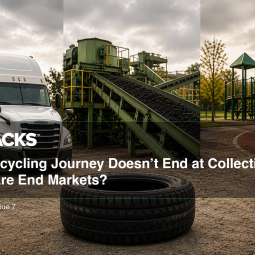
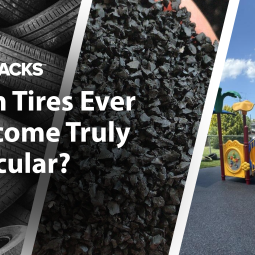
Recovered tire rubber may be used in agricultural matting, recreational surfaces, construction materials and rubber-modified asphalt. Steel can be prepared for an appropriate market. Options for recovered fibre depend on its composition and cleanliness, as well as available technology and demand.
These factors connect processing with real-world applications. When recovered materials do not meet an end user’s requirements, their options may be limited.
Circularity Also Has Practical Limits
Keeping resources in circulation for as long as practical does not mean every material can be recovered indefinitely.
Products wear down, and materials may become contaminated or lose quality through repeated use and processing. Logistics must also be feasible, with end users available to accept the resulting resources.
Understanding these limitations can reveal where better product design, new technology, stronger infrastructure or expanded markets are needed. It allows organizations to focus on realistic improvements rather than treating circularity as a single, perfect solution.
Keeping Circularity in Motion
Circular Economy Month is an opportunity to recognize the connected work behind a more circular economy.
For Ontario’s end-of-life tires, that work includes accessible collection, efficient transportation, effective processing, accurate reporting and viable markets. eTracks supports this coordination by arranging services and providing the information needed for reporting and accountability.
Circularity is built through informed decisions and collaboration across the system, helping keep tires and their materials in use for as long as practical.