Proportionate Tire Collection Where it Matters Most
Ontario’s tire recycling system is based on each producer meeting specific requirements to collect and recover a certain tonnage of tires, also known as a Minimum Management Target (MMT) and to ensure they ‘manage and operate’ a compliant collection network across the province. The MMT is calculated based on the producer’s sale to market from the previous 3, 4 and 5 years, and can be met through reuse, retreading or processing (e.g. “crumbing”), each having a different recovery rate*.
*Recovery Rate: In tire recycling, a recovery rate is the percentage of old, discarded tires that are successfully collected and put to a useful new purpose instead of going to a landfill. This includes tires made into new products, re-used or retreaded.
Once tires reach their end-of-life (EOL), it’s neither operationally nor economically feasible to separate and collect millions of tires by brand (individual producer, importer or automaker). Instead, collection occurs from physical sites where tires accumulate, with producer obligations measured by weight rather than brand.
During the current surge in Ontario scrap tire volumes, eTracks looks beyond minimum regulatory targets by collecting in proportion of its producer customers overall market share. In eTracks’ view, proportionate share is relative to and determined by market share (e.g. eTracks should fairly collect at least 68.9% of the scrap tires used and available for physical collection in Ontario according to its market share). For the system to function during the current surge in scrap tire volumes, servicing physical sites where tires are accumulating continues to be eTracks’ priority.
The total volume of scrap tires and collection activity taking place in the Ontario market is only revealed the following year, making proportionate market share of collection efforts largely invisible until totals are assessed and revealed. Invisibility is further amplified if total proportionality is viewed as a blending of all types of tire recovery (physical tire collection for processing (85% recovery) vs retreading (117% recovery) vs reuse (100% recovery), i.e. if physical tire collection from sites and retreading are viewed as the same effort; the imbalance adds pressure to the system experiencing a slow-down in physical tire collection.
A medium truck tire, or off-the-road tire can be retreaded multiple times and is only physically collected once before retreading and once after it’s retreaded 2-4+ times in its life-cycle. Retreading occurs in its own eco-system (retreading facilities, trucking companies, etc.) and while it supports positive environmental outcomes by keeping a tire in use longer, it does not address the current backlog when the vast majority of tires cannot be retreaded (or re-used) and still require individual collection for recycling.
From a life-cycle perspective, retreading creates more environmental benefit than simply recovering rubber and steel after shredding a scrap tire for recycling. To encourage producers to retread as many tires as possible, Ontario’s Tire Regulation incentivizes retreading with a higher recovery weighting than a recycled tire. The incentivized weighting on retreading a scrap tire can then be used towards achieving a producers’ management target multiple times until the tire casing wears out and the tire is recycled. (A casing is the bare tire stripped of old tread that new tread is applied to during the retreading process). Comparatively, a passenger and light truck tire typically has two lives, its initial use and it’s use once it’s recycled into an end market material.
The current backlog reflects a mix of regulation, market behaviour, collection logistics and public expectations. eTracks continues to manage significantly higher tire collection requests while working through the backlog responsibly, with most sites in our network being serviced quarterly or more frequently. Surging tire volumes in Ontario continue to present challenges.
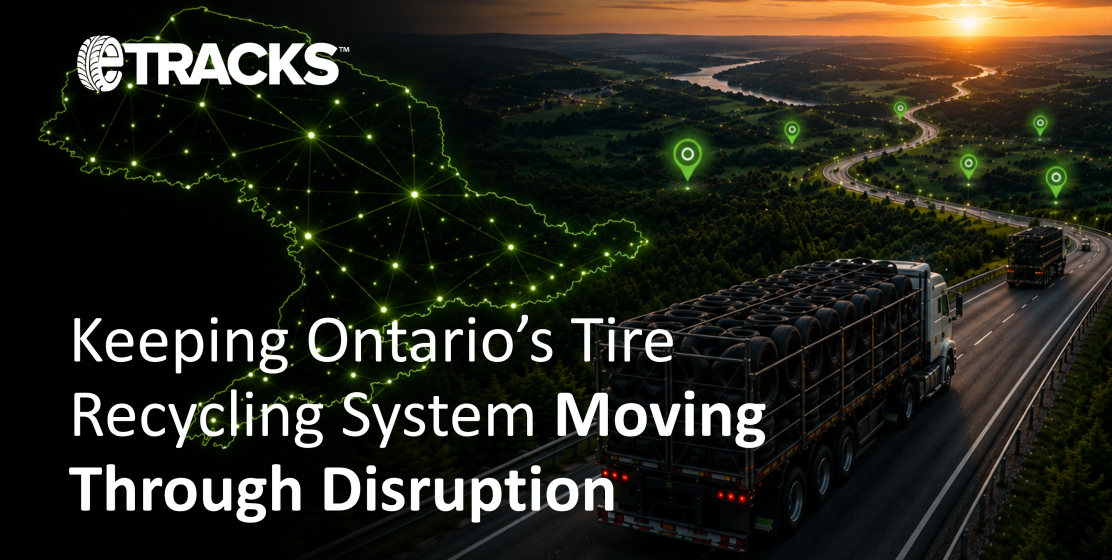
eTracks’ province-wide network of 5,500 active collection sites feeds a network of eight Ontario tire processors and more than 50 Ontario hauling companies, collectively employing hundreds of Ontarians. This diversity in processing and hauling services means tires can be collected from North to South and East to West with delivery options at the most efficient points possible. Together this supports a tire recycling system that is both an environmental service and an economic driver to Ontario’s economy.
eTracks continues to facilitate collective producer compliance, including small, medium and large tire producers. Our not-for-profit model helps producers meet obligations, aligning fees and service expectations with actual system needs.
Ongoing disruption continues to test Ontario’s tire recovery system and has reinforced eTracks’ purpose: ensuring our producer customers do their part to support a return to reliable physical collection and keeping used tires moving toward responsible environmental outcomes. Ontario needs practical solutions, shared accountability and a renewed focus on keeping tires out of stockpiles and moving into productive reuse and recovery. This remains our core focus, and we will continue to work to stabilize and grow both the capacity and resiliency of Ontario’s tire recycling sector now and in the years to come.